Buy
Showing posts with label Cyber Security. Show all posts

Thursday, July 11, 2024

Our Cloud/Modernization Strategy - We Impost ZERO TRUST in the Cloud

Folks,

Hello. I hope this finds you doing well. Let me begin by saying that we are slated to make a small announcement today or tomorrow, and this post is NOT that announcement. That should likely follow in a few hours, or tomorrow.


Our Cloud/Modernization Strategy - We Impose ZERO TRUST in the Cloud

In this post, I wanted to take a few moments to share our Cloud/Modernization strategy.

There appears to be a narrative in the world, likely funded by the world's many Cloud Computing companies, that every organization ought to consider and implement a Cloud/Modernization strategy, or risk getting left technologically behind.

At the core of this narrative appears to be a strong (but inaccurate) message that the Cloud is inherently more trustworthy and cost-effective to use than the traditional computing systems that most of the world's organizations operate on today.


A closer look reveals that such narratives/their core principles seem to emanate from and be delivered to a global audience via guidance from government organizations tasked with promoting "American innovation and industrial competitiveness", published in the form of high-level guidance, which American cloud computing companies seize the opportunity to quote.

It also seems that such narratives/initiatives seem to provide certain vendors of operating systems and hosting providers (, mostly American Corporations,) a golden opportunity to additionally have their entire global organizational customer base now also pay them, on a recurring basis, for a host of new computing and cyber security services built, marketed and labelled as the 'Cloud.'

To further worsen the situation, it appears that some of these vendors seem to invest billions of dollars in sophisticated marketing strategies, to not only get some of these initiatives to become part of American Government policy, but also to convince/persuade the "C-Suite" at their global organizational customer base, to transition assets over to their Cloud.

Little do these hapless organizational customers from across the world seem to realize that whilst embracing these new services marketed as the Cloud may sound rosy and secure, in reality, it requires (involves) them to basically relinquish* operational control (autonomy) and privacy, and take on an eternal dependency on an external third-party.

* The moment an organization transitions its primary identities into the Cloud is the moment it loses its operational autonomy.

The world's organizations and their shareholders may want to contrast this with the undeniable fact that the alternative, i.e. operating on traditional computing systems upon which the world has been successfully operating for years now, does NOT require organizations to relinquish their operational autonomy, privacy or security, i.e. give up their sovereignty.


It appears that this paramount fact, one that directly impacts the security, autonomy and sovereignty of every organization, and in the case of governments, also impacts national sovereignty and national security, is astonishingly overlooked!


The Cloud is a No-Starter for Us

It likely cannot be stated any simpler than someone already has - "The Cloud is just someone else's computer."

The world ought to understand, in no uncertain terms, that the moment you put your assets onto someone else's computer, they are no longer, either private OR solely yours. They can be accessed by, copied, modified and destroyed by ANYONE who has ADMINISTRATIVE or sufficient access to that computer, or anyone who could gain UNAUTHORIZED access to it, including 1000s of the Cloud provider's personnel (, whose identities/computers too could be compromised and misused.) 

Further, because these Cloud providers are starting to be used by thousands of organizations, they themselves are now MASSIVE targets for highly proficient, and often state-funded adversaries, and their compromise could easily cascade.

Finally, when you use an Identity Provider (IDP), you must understand that that IDP now knows exactly who you are, where you are, what you are logging on to, and what you are accessing. In other words, you have no privacy left. None.

For starters, for that reason to begin with, the Cloud is a no-starter for us.


Concluding Thoughts

My time is very valuable so I will not spend more time on this. Time permitting, I may pen another blog post in the future with sufficient (concrete) technical details, but for now, this is all I wish to say, and have time to say regarding the Cloud. 

Let me be very clear - we are perfectly capable of offering the most technologically advanced services in the Cloud as well, but since it is conceptually a no-starter for us, we do not invest time or resources to build and offer Cloud based services.


In short, at Paramount Defenses, we literally impose zero trust in the Cloud, and since we know how to operate a secure IT environment, we do NOT rely on anyone i.e. any Cloud provider to operate our internal organizational IT infrastructure.

As a result, we fully retain our operational autonomy, organizational privacy and cyber security. 


That's all I have to say about it. As a well-wisher, I encourage the entire world to consider the perspective shared above.

Thanks,
Sanjay


Friday, March 15, 2024

We're Giving Away up to $ 100 Million in Software

Folks,

Hello. Today is our eighteenth anniversary, and to celebrate this occasion, and help thousands of organizations worldwide that operate on Active Directory, today we announced our intent to give away up to $ 100 Million worth of Gold Finger licenses to all organizations that can affirmatively answer just one simply question concerning Active Directory security.

Details on our up to $100 Million software giveaway can be read in our press release - Paramount Defenses Celebrates Eighteen Years in Business, Announces Up To $100 Million Software Giveaway | Business Wire

We cordially invite all organizations worldwide to kindly take us up on our generous offer, and we hope that organizations worldwide will give a serious thought to the one question that we have asked. If you ask me, it's a really simple question and the answer is either a Yes, or a No. If it's a No, then they must ask themselves how secure they actually are today. 


Over the last eighteen years, we have pioneered, perfected and automated the incredibly difficult and sophisticated art of accurate access assessment, particularly in Active Directory and as pioneers and industry leaders in access assessment, we remain committed to helping organizations securely operate their foundational Active Directory infrastructures.

That's all for now. Thank you very much. I wish you well. I'll leave you with this.

Best wishes,
Sanjay 


Wednesday, March 6, 2024

World, Hello Again

Folks,

Hello. I hope this finds you doing well. It has been almost two years since we last penned a post here on our blog.

The silence was intentional, and now it is TIME to break our silence. We have been hard at work, quietly, working on two new products, GG and TB (, one of which targets the Cloud), and both of which, like GF (Gold Finger) could* easily substantially impact the foundational cyber security of thousands of organizations worldwide, including Microsoft's.

*If the need were to arise, as and when it does, we will unveil them.


For now though, our focus continues to be on Gold Finger, which remains unrivaled and indispensable for Active Directory Security. Today, amongst many organizations worldwide, Gold Finger helps secure and defend $100 Billion+ companies.

Speaking of which, today we announced the availability of Gold Finger Version 8.0 with support for Windows 11.


Active Directory remains Foundational

Microsoft Active Directory is a mature, time-tested and provably trustworthy technology that enables and empowers organizations to autonomously operate the lifeline of their business, their IT infrastructures. Those who claim that Active Directory is not secure, may not know enough about Active Directory security.

Active Directory is one of the most highly securable technologies in the world today, and its powerful security model enables organizations that possess the right capabilities to be able to easily attain and maintain least privileged access (LPA) and independently operate highly resilient foundational IT infrastructures.

In days to come, we will help the world understand how to easily attain and maintain LPA in Active Directory.


Helping Organizations Retain their Operational Autonomy, Privacy and Dignity

Today, we also reiterated our commitment to helping organizations worldwide securely operate Active Directory.

Thousands of organizations worldwide are realizing for themselves what we have been saying for years i.e. the day they relinquish control of their primary identities (such as to an IDP in the Cloud) is the day they will have relinquished their operational autonomy and privacy, forever, and taken on an eternal dependency on a third-party. 

Of course, should such an IDP be compromised, their organization could also instantly be at risk of compromise.

In contrast, organizations that retain control over their primary identities i.e. organizations whose primary identities reside in their Active Directory, will continue to enjoy operational autonomy, safeguard their privacy and preserve their dignity.

In days to come, we will also help organizations worldwide understand how to easily secure Active Directory.


That's all for now. There's a lot we have to share, and in coming days, you can expect us do so.

Best wishes,
Sanjay 


Wednesday, April 27, 2022

Active Directory - The World's Most TRUSTWORTHY Foundational Technology


Folks,

Today I'd like to share a few thoughts with you on one the most important topics in all of organizational security - i.e. which FOUNDATIONAL technology should organizations be operating upon today? I will make the case of Active Directory (🔺).


Microsoft Active Directory - The World's Most Trustworthy Foundational Technology

For the last twenty years, the entire world has successfully operated on a highly trustworthy foundation - Active Directory.

Indeed, from the entire United States Government to virtually the entire global Fortune 1000, today over twenty thousand government and business organizations in over one hundred and ninety countries operate on Microsoft Active Directory.

Active Directory has stood the test of time and is the most trustworthy foundation that organizations can operate on today.


While some may view Active Directory as merely an Identity Provider (IDP), in reality, it is substantially more than that. 


Active Directory is -

  1. An enterprise-grade multi-mastered directory service that offers unrivaled availability, fault-tolerance and resilience. 

  2. A Kerberos realm that enables enterprise-wide trustworthy network authentication and seamless single sign-on.

  3. The Foundation of Authentication, Authorization and Auditing (AAA) that empowers organizations to precisely control network user authentication, secure authorization to IT resources and auditing for all vital AA actions.

  4. The Heart of Identity and Access Management (IAM) considering that the entirety of an organization's identities (and their credentials) and security groups reside in and are secured and managed in Active Directory.   

  5. The Heart of Privileged Access and Enabler of Least Privileged Access (LPA) considering that the most powerful privileged accounts are stored, secured and managed in it -AND- that privileged access for all salient aspects of identity and access management can be precisely provisioned/delegated based on the principle of least privilege.    

  6. The Control Center for Centralized Host and Security Management that via Group Policy enables organizations to easily, efficiently and comprehensively control and manage all endpoints -AND- their security.

  7. The Foundation for Zero Trust considering that Zero Trust is fundamentally about ensuring that all access is provisioned based on the principle of least privilege (i.e. LPA), and in environments powered by Active Directory, access for all aspects of identity and access management is provisioned, controlled and audited in Active Directory.


In addition, Active Directory lets organizations easily enable seamless single sign-on to external systems via federation, and it can be synchronized with secondary IDPs like Microsoft Azure to facilitate SSO access to Cloud based services.


Finally, contrary to popular belief, Active Directory can* in fact be easily, efficiently and reliably operated and secured. 

However, the most important and overlooked strength of Active Directory is that enables and empowers organizations to be able to autonomously and independently operate their IT infrastructures, without any eternal external dependencies, without having to expose the entire organization to the Internet, and without having to incur a dime of additional cost.


Conclusion

In essence, today, an organization's Active Directory deployment is the very foundation of its cyber security, the heart of privileged access and the bedrock of organizational security, which makes it an extremely valuable organizational asset.

Above all, it lets organizations independently operate, highly trustworthy, self-reliant and fixed-cost IT infrastructures, in contrast to having to relinquish all control and transition to relatively new, constantly costing, third-party operated services.


In conclusion, when it comes to cyber security, technical maturity, operational excellence and autonomous operation, today, no technology can rival the trustworthiness, resilience and autonomy that Active Directory offers organizations.


Best wishes,
Sanjay Tandon

Formerly
Program Manager
Active Directory Security
Microsoft Corporation

Tuesday, May 18, 2021

What's common between the Colonial Pipeline Hack and SolarWinds Breach?


Folks,

From the entire U.S. Government to the Fortune 1000, including almost all cyber security and cloud computing companies, today, at the foundation of IT, cyber security and privileged access at 85% of organizations worldwide lies Active Directory.

I'm Sanjay Tandon, formerly Program Manager for Active Directory Security on Microsoft Corporation's Windows Server Development Team, and today, CEO of Paramount Defenses.


Today, I'll share with you what is common between the Colonial Pipeline Hack and the SolarWinds Breach, and day after tomorrow onwards, I'll also provide sufficient technical details, but before I do so, I would like to share a few observations. 


Note - The only reason you may want to listen to what I have to say, is because, by virtue of my years at Microsoft and PD, I possess sufficient expertise, IP and capability to be able to help substantially enhance (and if requested, also demo how one could compromise) the foundational cyber security of any/every organization in the world.


Five Observations

I would like to share a few salient observations on the current(ly dismal) state of cyber security at organizations worldwide, because it is my professional opinion that until certain basic deficiencies are addressed, unfortunately, we will continue to witness many more such breaches - 


  1. The Current State of Affairs

    It is really sad to see the current state of cyber security at organizations worldwide. Not a month seems to go by without there being yet another high-impact cyber security breach at some prominent organization or the other.

    That said, considering how inadequate the actual state of cyber security preparedness, defenses and proficiency are at most organizations, it is hardly surprising to see so many organizations get breached, ransomware'd etc.

    For instance, consider this - Active Directory (AD) is the very foundation of cyber security at organizations, and a Domain Controller (i.e. the machine on which AD is hosted) is technically the most valuable asset an organization has, yet, at most organizations, DCs remain vastly inadequately protected, and thus vulnerable to compromise.

    If this is the state of DC security at thousands of organizations worldwide, how can there be any security?

    Likewise, the compromise of a single Active Directory Privileged User account is tantamount to a complete Active Directory forest-wide breach, so such accounts must be minimal in number and highly protected. Yet, at most organizations, today there exist an excessively large and unknown number of Active Directory privileged accounts.

    If this is the state of AD privileged accounts at most organizations worldwide, how can there be any security? 


  2. Three Fundamental Deficiencies

    It is my professional opinion that most organizations suffer from three key deficiencies, that ultimately result in inadequate cyber security defenses, leading to breaches - understanding, accountability and empowerment.     

    1. Understanding - Given a vast and dynamic attack surface, and sophisticated threats, it is imperative that all organizations possess a sufficient understanding of how to adequately protect themselves, yet most don't.

    2. Accountability - Security requires a clear chain of ownership and accountability:  Shareholders, customers, partners > CEO > CISO > Director(s) > Domain (and IT) Admins. Yet at most organizations, none exists.

    3. Empowerment - Organizational IT teams need to be adequately empowered to acquire and deploy security measures needed to adequately defend an organization, yet at most organizations, budgets are inadequate.


    For instance, IT personnel and Domain Admins from thousands of organizations have requested our help, found our unique products (e.g. 1, 2, 3) to be essential, yet so many end up conveying that they just do not have the budget.

    In reality, it is not that they do not have the budget; it is primarily that their executive management simply does not yet possess the required understanding i.e. Active Directory Security directly impacts foundational security and business continuity, and is thus paramount, and consequently their IT personnel are simply not empowered. 


  3. The World is Mostly Reacting

    Sadly, at most organizations, cyber security is only taken sufficiently seriously after they have been breached, and in most instances, the response is similar - the breach is disclosed, then FireEye is called in to investigate, and ultimately, promises are made to enhance security. In the case of govts., broad directives/EOs may be issued.

    FireEye does a thorough investigation and in most cases, the findings are similar i.e. the perpetrators used the same set of well-known techniques and in almost every case, compromised and misused an Active Directory privileged user account to obtain Domain Admin level access, which was then used to achieve their objective. 

    Subsequent to FireEye's investigation, this is priority #1, budget is no longer a problem, a new CISO is hired, half a dozen new cyber security solutions are deployed, millions are spent etc. but the damage has already been done.


  4. Lack of Specifics in Public Discourse

    After every breach, the CNNs and ABCs of the world will extensively cover it, you'll hear interviews from prominent Senators, Congressmen and cyber-security experts, all of whom will speak about the serious impact, the role in national security, the influence of a foreign power etc., yet not one of them mention one piece of specific detail.

    In the absence of details in the public discourse, the actual problem, and the solution that it requires, will largely remain unaddressed, and most cyber security companies out there will likely use this opportunity to convince organizations to deploy their latest cyber security solutions, whether or not they actually make a difference. 

    As a result, in all the noise, and due to the lack of focus on details, the actual specific deficiency/weakness that was exploited, and the attack vector that was used in a specific breach, will often likely continue to remain unaddressed at thousands of other organizations worldwide, paving the way for the next breach and the one after it, and so on.

    For instance, in virtually every major cyber security breach to date, the most damaging part of the breach was made possible by the perpetrator compromising and misusing a single Active Directory privileged user account to fulfill his/her objective, whether it be exfiltrating data, unleashing malware etc. and yet to date, at most organizations worldwide, no one has any idea as to exactly how many users have privileged access in Active Directory because the elephant in the room, i.e. "Active Directory", was not mentioned even once in the public discourse.


  5. The Basics - Secure the Foundation and Deny them the Opportunity

    At its simplest, all security is fundamentally about access control. In order to compromise anything, perpetrators require access - if we reliably deny them the required access, we will have won half the cyber security battle.

    Most importantly, if perpetrators are unable to obtain privileged access, specifically Domain Admin equivalent access, they will almost never able to inflict colossal damage i.e. no widespread ransomware, data exfiltration, etc.

    Towards that end, the most important proactive measure organizations can take to adequately defend themselves is to adequately secure and defend their foundational Active Directory deployments, the two most important parts of which are to 1) secure all DCs (and admin workstations), and 2) accurately identify and minimize the number of accounts that possess privileged access in Active Directory, then fiercely protect every AD privileged account.

    Here's why - An attacker only needs to compromise one DC or one AD privileged user account. That's it. Just ONE.

    Real-world Evidence - If the perpetrators of the Colonial Pipeline attack had not been able to compromise a DC, they would likely not have been able to unleash ransomware. Likewise, if the perpetrators in the SolarWinds Breach had not been able to compromise an Active Directory privileged user account, they would not have been able to gain access to and exfiltrate vast amounts of data on-prem and in the Cloud, at thousands of organizations. 


  • Note - If you find this to be high-level and light on technical details, it is so by intent, given its purpose. For those who may wish to judge my competency based on details - one, two, three, four, five, sixetc..

    I've also written an innocuous production-level ransomware example to show it could be AD deployed.


What is common between the Colonial Pipeline Hack and the Solar Winds Breach?

In the last few months, two major cyber security incidents, the SolarWinds Breach and the Colonial Pipeline Hack have had a notable impact on the world, the former having impacted the security of thousands of organizations worldwide, and the latter having caused a week long shutdown of the largest oil pipeline operator in the eastern United States.

The one thing that both these attacks had in common was that in each of these cyber security incidents, the perpetrators specifically targeted and successfully compromised the foundational Active Directory deployments of organizations.


Note - The compromise of a single Domain Controller and/or a single Active Directory privileged user account is tantamount to the compromise of an organization's entire foundational Active Directory deployment.


It can be stated with a high degree of certainty that had the perpetrators not been able to compromise the foundational Active Directory deployments of these organizations, in all likelihood, these attacks would not have been successful.

I'll share the relevant technical details of both of these attacks, on this blog, starting day after tomorrow, as stated below.  


Trillion $ Insights

Over the next few days, starting day after tomorrow, I'll share ten specific high-value details that have a direct bearing on the foundational cyber security of every organization operating on Active Directory today; you may wish to tune in.

Day after tomorrow, I'll share the details of what enabled the most impactful part of the SolarWinds Breach right here, and in days to come, I'll also share what enabled the most impactful part of the Colonial Pipeline Hack here.

Sincerely,
Sanjay.

Founder and CEO, 


PS: I am often asked for advice on how to secure Active Directory. 
It being an ocean of a subject, here's the essence of it -

In the hierarchy of security measures, prevention is #1, avoidance is #2, detection is #3 and remediation is #4.

I. Prevention - The most effective measure is prevention; the most effective way of preventing an AD breach is as follows: 
  1. Adequately secure and defend every single domain controller (and if used, privileged admin workstations (PAWs))
  2. Accurately identify and minimize the number of privileged accounts in Active Directory, then protect all of them.
  3. Always follow secure admin practices e.g. do NOT logon to any machine except PAWs using Domain Admin creds.

II. Detection - You may wish to consider using an AD Security Monitoring /Threat Intelligence solution to gain visibility and detect enactment of attacks. It is important to keep in mind that such solutions usually monitor replication so they provide quick but "after-the-fact" insights. In general, the efficacy of such solutions is a function of the timeliness of your response.

III. Remediation - You may wish to consider using an AD Backup and Restore solution, in the event of an incident. An AD restore is an extremely complicated and expensive operation, not to be taken lightly, and only to be used as a last resort.

Wednesday, May 5, 2021

The $ 25,000 Gold Finger Mini Challenge

Folks,

I hope this finds you doing well. Today, we are announcing our second global Gold Finger Mini Challenge for US $ 25,000.


The $ 25,000 Gold Finger Mini Challenge


We are excited to announce an award of US $ 25,000/- to the first individual who can identify any solution in the world, other than Gold Finger, that can demonstrably do what the Advanced level of Gold Finger Mini can. Details below -


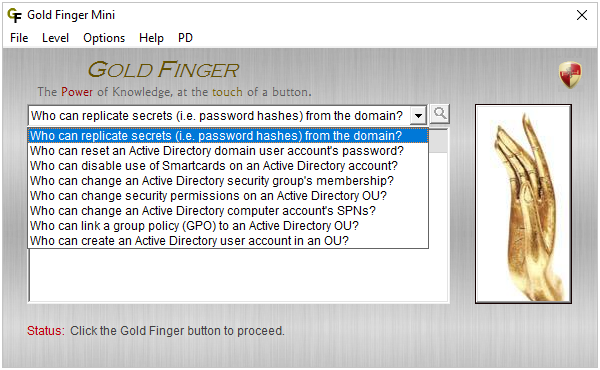
Here are the Top 7 Active Directory Privileged Access Audit that the Advanced level of Gold Finger Mini can provide -   
  1. Who can replicate secrets (password hashes) from an Active Directory domain? 
  2. Who can reset the password of an Active Directory domain user's account?
  3. Who can disable the use of Smartcards on an Active Directory account?
  4. Who can change an Active Directory security group's membership?
  5. Who can change security permissions on an Active Directory OU?
  6. Who can link a group policy (GPO) to an Active Directory OU?
  7. Who can create an Active Directory user account in an OU? 

The need to know exactly who can enact these privileged tasks is absolutely paramount.


Paramount Privileged Access Insights

The unauthorized, accidental or coerced enactment of virtually all administrative tasks listed above could instantly result in a colossal breach far greater (damaging) in impact than even the recent SolarWinds Hack.


Consider this -
  1. Anyone who could replicate secrets from Active Directory, effortlessly enactable via the use of Mimikatz DCSync, could instantly compromise the credentials of all (thousands) of organizational domain user accounts resulting in a colossal breach bigger than the Solar Winds Hack.

  2. Anyone who could reset the password of a domain user account would in effect have instantly compromised the identity of that account, such as that of a C-Level Executive, a Software Developer etc. He/she could then login as that account and instantly obtain access to everything that account has access to. If the target were an Active Directory privileged user account, it would be tantamount to a colossal, system-wide breach.

  3. Anyone who could disable the use of Smartcards for interactive logon, would in effect have downgraded security on that account, forcing authentication to being password based, and a simple password reset of that domain user account could be used to instantly compromise it.

  4. Anyone who could change the membership of a domain security group could instantly obtain domain-wide access to all IT resources that the compromised group has access to, such as All Employees, Source-Code Access, AccountingCloud Global Admins etc. If the target were an Active Directory privileged group, such as Domain Admins, it would be tantamount to a colossal, system-wide breach.

  5. Anyone who could modify the security permissions on an Active Directory OU could easily gain privileged access on all Active Directory objects e.g. user accounts, computers, security groups, service connection points etc. that reside in that OU. In numerous ways, this could easily be used to elevate/escalate privilege and gain Domain Admin equivalent access, resulting in a colossal breach.

  6. Anyone who could link a GPO to an Active Directory OU could instantly control the security of all computers whose domain computer accounts reside in that OU. This could be used to easily circumvent all endpoint-protection controls, deliver malicious payloads or instantly unleash malware on thousands of domain-joined computers.

  7. Anyone who could create a domain user account in Active Directory could then use that account to engage in nefarious activities that couldn't be traced back to a uniquely identifiable individual, thereby enabling the perpetrator to evade accountability while engaging in nefarious recon or attack activities.  

Consequently, the need to know exactly who can enact these administrative tasks in an organization's foundational Active Directory deployment is absolutely paramount to organizational cyber security today. 


The $ 25,000 Challenge

Our challenge is simple. All you need to do is -
  1. Try the Advanced level of Gold Finger Mini, downloadable from here, to experience its unique capabilities.

  2. Identify any solution in the world, other than Gold Finger, that you believe can do what Gold Finger Mini can.

    Specifically - Identify any solution in the world that can accurately deliver the 7 paramount insights listed above.

  3. Compare and verify the results of the identified solution with Gold Finger Mini's results in the same AD domain. For your convenience, a ready to use lab AD domain with Gold Finger Mini pre-installed, can be downloaded from here.

If you believe you have found a solution, email its name to us at challenge[@]paramountdefenses.com. If you don't find a solution, but wish to be eligible for our next challenge (see below), email us and let us know that you didn't find a solution.  


List of Popular Active Directory Security Solutions

To help make it easy for you to find other solutions that you could compare Gold Finger Mini with, here is a list of various Active Directory Security Solutions available today, listed in alphabetical order -
  1. Acldiag (Microsoft)
  2. Aclight (CyberArk)
  3. Active Directory ACL Analyzer* (Paramount Defenses)
  4. Active Directory ACL Exporter* (Paramount Defenses)
  5. Active Directory Effective Permissions Calculator* (Paramount Defenses)
  6. Active Directory Effective Access Auditor* (Paramount Defenses)
  7. Active Directory Membership Auditor* (Paramount Defenses)
  8. Active Directory Permissions Analyzer* (Paramount Defenses)
  9. Active Directory Permissions Reporting Tool (ManageEngine)
  10. Active Directory Privileged Access Auditor* (Paramount Defenses)

  11. Active Directory Security Auditor* (Paramount Defenses)
  12. AD ACL Scanner (Robin Granberg ?)
  13. AD Permissions Reporter (CJWDev)
  14. AD Secure (Attivo Networks)
  15. AD Assessor (Attivo Networks)
  16. Alsid for AD (Alsid)
  17. BeyondTrust Auditor (BeyondTrust)
  18. Bloodhound (SpectreOps)
  19. CrowdStrike Falcon Identity Protection (CrowdStrike)
  20. Dsacls (Microsoft)

  21. Directory Service Protector (Semperis)
  22. Effective Permissions Reporting Tool (Netwrix)
  23. Enterprise Reporter for Active Directory (Quest)
  24. Hyena (Systemtools)
  25. LepideAuditor (Lepide)
  26. Permissions Analyzer for Active Directory (SolarWinds)
  27. Ping Castle (Ping Castle)
  28. PowerShell for Active Directory (Microsoft)
  29. Purple Knight (Semperis)
  30. StealthAUDIT Active Directory Permissions Analyzer (Stealthbits)
  • * These tools are a part of the Gold Finger Suite and are thus not eligible for consideration

If there are any tools that are not on this list but should be, simply leave a comment below, and we will add them to the list.


Submission Deadline

The deadline for submitting an entry for our second challenge is May 16, 2021 i.e. all entries received by 23:59:59 U.S. PST on May 16, 2021 will be eligible for participation. The winner will be announced on May 20, 2021 on this blog.

The timestamp at which your email is received will determine the order of submissions. The first submission that identifies a solution other than Gold Finger, that can accurately do what Gold Finger Mini can i.e. deliver the 7 paramount insights listed above, will be the winner. If no submission is able to demonstrably identify such a solution, there will be no winner.


The Next Challenge

We will be issue our next challenge on May 21, 2021. The reward for the next challenge will be US $ 50,000/-.
However, only those individuals who participate in this challenge will be eligible to participate in the next challenge.  


Summary

Almost all major breaches in the last decade, including the SolarWinds Hack, involved the compromise and misuse of just one Active Directory privileged user account. Of note, the SolarWinds hackers only targeted Active Directory environments.
The objective of this challenge is to help organizations as well as IT and cyber security personnel worldwide become aware of the paramount importance of knowing exactly who has what privileged access in Active Directory, and to help organizations realize just how substantially inadequate their existing Active Directory audit toolsets are today.

We hope that this will be an educational challenge for all IT and cyber security professionals worldwide, and we look forward to hearing from everyone who understands the paramount importance of Active Directory Security.


Thank you.

Kindest regards,
Sanjay Tandon.

Chairman and CEO,
Paramount Defenses


Your participation is subject to the Terms of Use of our website and our Privacy Policy.

Wednesday, April 21, 2021

Introducing the $ 10,000 Gold Finger Mini Challenge

Folks,

I hope this finds you doing well. Today, we are announcing our first $ 10,000 global Gold Finger Mini Challenge.


The $ 10,000 Gold Finger Mini Challenge


We are excited to announce an award of US $ 10,000/- to the first individual who can identify any solution in the world, other than Gold Finger, that can demonstrably do what Gold Finger Mini can, i.e. instantly and accurately determine exactly who can enact the most critical privileged administrative tasks in an Active Directory domain.


Here are the Top 5 Active Directory Privileged Access Audit Insights that Gold Finger Mini can uniquely provide -   
  1. Who can replicate secrets (password hashes) from an Active Directory domain? 
  2. Who can change security permissions on the AdminSDHolder object?
  3. Who can change the membership of the Domain Admins security group?
  4. Who can reset an Active Directory privileged user account's password?
  5. Who can disable the use of Smartcards on an Active Directory user account?

The need to know exactly who can enact these privileged tasks is absolutely essential to securing Active Directory.   


The Challenge

The challenge is simple. All you need to do is -
  1. Try the free version of Gold Finger Mini, downloadable from here, to become familiar with its unique capabilities.

  2. Identify any solution in the world, other than Gold Finger, that you believe can do what Gold Finger Mini can.
    Specifically, identify any solution in the world that can accurately deliver the 5 paramount insights listed above.

  3. Compare and verify the results of the identified solution with Gold Finger Mini's results in the same AD domain. For your convenience, a ready to use lab AD domain with Gold Finger Mini pre-installed, can be downloaded from here.

If you believe you have found a solution, email its name to us at challenge[@]paramountdefenses.com. If you don't find a solution, but wish to be eligible for our next challenge (see below), email us and let us know that you didn't find a solution.  

That's it!


List of Active Directory Security Solutions

The following is a list of various Active Directory Security Solutions available today, listed in alphabetical order -
  1. Acldiag (Microsoft)
  2. Aclight (CyberArk)
  3. Active Directory ACL Analyzer* (Paramount Defenses)
  4. Active Directory ACL Exporter* (Paramount Defenses)
  5. Active Directory Effective Permissions Calculator* (Paramount Defenses)
  6. Active Directory Effective Access Auditor* (Paramount Defenses)
  7. Active Directory Membership Auditor* (Paramount Defenses)
  8. Active Directory Permissions Analyzer* (Paramount Defenses)
  9. Active Directory Permissions Reporting Tool (ManageEngine)
  10. Active Directory Privileged Access Auditor* (Paramount Defenses)
  11. Active Directory Security Auditor* (Paramount Defenses)
  12. AD ACL Scanner (Robin Granberg ?)
  13. AD Permissions Reporter (CJWDev)
  14. AD Secure (Attivo Networks)
  15. AD Assessor (Attivo Networks)
  16. Alsid for AD (Alsid)
  17. BeyondTrust Auditor (BeyondTrust)
  18. Bloodhound (SpectreOps)
  19. CrowdStrike Falcon Identity Protection (CrowdStrike)
  20. Dsacls (Microsoft)
  21. Directory Service Protector (Semperis)
  22. Effective Permissions Reporting Tool (Netwrix)
  23. Enterprise Reporter for Active Directory (Quest)
  24. Hyena (Systemtools)
  25. LepideAuditor (Lepide)
  26. Permissions Analyzer for Active Directory (SolarWinds)
  27. Ping Castle (Ping Castle)
  28. PowerShell for Active Directory (Microsoft)
  29. Purple Knight (Semperis)
  30. StealthAUDIT Active Directory Permissions Analyzer (Stealthbits)
  • * These tools are a part of the Gold Finger Suite and are thus not eligible for consideration

If there are any tools that are not on this list but should be, simply leave a comment below, and we will add them to the list.


Submission Deadline

The deadline for submitting an entry is May 16, 2021 i.e. all entries received by 23:59:59 U.S. Pacific Standard Time (PST) on May 16, 2021 will be eligible for participation. The winner will be announced on May 20, 2021 on this blog.

The timestamp at which your email is received will determine the order of submissions. The first submission that identifies a solution other than Gold Finger, that can accurately do what Gold Finger Mini can i.e. deliver the 5 paramount insights listed above, will be the winner. If no submission is able to demonstrably identify such a solution, there will be no winner.


The Next Challenge

We will be issuing our next challenge on May 21, 2021. The reward for the next challenge will be US $ 25,000/-. However, only those individuals who participate in this challenge will be eligible to participate in the next challenge.  


We hope that this will be a fun, rewarding and educational challenge for all IT and cyber security professionals worldwide, and we look forward to hearing from everyone who understands the paramount importance of Active Directory Security.

Thank you.

Kindest regards,
Sanjay Tandon.

CEO,
Paramount Defenses


Your participation is subject to the Terms of Use of our website and our Privacy Policy. No purchase is necessary to participate in this challenge. This challenge is open to citizens of all nations except Cuba, Iran, North Korea, Syria, Yemen and those against which the U.S. Government may have imposed sanctions.

Wednesday, February 10, 2021

Introducing the Advanced Level of Gold Finger Mini

Folks, 

Today, I'd like to introduce you to the Advanced Level of Gold Finger Mini, quite possibly the world's most capable and powerful cyber security solution -
Gold Finger Mini is the world's only cyber security solution (other than Gold Finger) that can accurately and instantly find out and reveal exactly who has the most powerful privileged access in Active Directory and its Advanced Level offers eight unrivaled fully-automated Active Directory Privileged Access reports that instantly determine and reveal who can enact the most powerful administrative tasks in Active Directory.


Unrivaled Privileged Access Insight

The reports in the Advanced Level of Gold Finger Mini were designed to empower IT personnel, Cyber Security Auditors, Penetration Testers, Ethical Hackers and CISOs at organizations worldwide instantly and accurately determine exactly -

  1. Who can replicate secrets (password hashes) from an Active Directory domain?

  2. Who can reset any Active Directory domain user account's password?

  3. Who can disable the use of Smartcards on any Active Directory account?

  4. Who can change any Active Directory security group's membership?

  5. Who can change permissions on any Active Directory OU (Organizational Unit) ?

  6. Who can change any Active Directory computer account's SPNs (Service Principal Names)?

  7. Who can link a group policy (GPO) to any Active Directory OU?

  8. Who can create an Active Directory user account in any OU?

The cyber security intelligence that these reports uniquely deliver are absolutely essential for securing Active Directory.

However, what you may not know is that, contrary to popular belief, it is very difficult to accurately find out who can enact these privileged tasks in Active Directory, because to do so, one needs to determine Active Directory effective permissions.

Gold Finger Mini is simply the world's only cyber security solution (other than Gold Finger) that can accurately determine effective permissions in Active Directory and accurately make these paramount determinations, at the touch of a button, so now everyone can instantly find out exactly who has the most powerful privileged access in any Active Directory. 


Instant, Unrivaled High-Value Intelligence

As you know, such critical information can be very valuable if you're performing an Active Directory Privileged Access Audit or an Active Directory Security Assessment or if you're trying to pen-test/ethically hack an organization's Active Directory.


If you could find out exactly who can replicate secrets (password hashes) from an Active Directory domain (e.g. by using Mimikatz DCSync), or who can change the membership of any Active Directory security group, such as Domain Admins, or who can reset the password of any domain user account, such as the Administrator account, or who can modify the ACL protecting an organizational unit (OU) that contains thousands of domain user and computer accounts etc. you'd be just one step away from being able to obtain Domain Admin level privileged access in an organization.

The Advanced Level of Gold Finger Mini empowers organizations to be able to instantly and accurately assess who has sufficient privileged access in Active Directory so as to be able to enact the most highly sensitive/powerful administrative tasks that could used to escalate privilege and consequently gain access to just about any IT resource in an organization.


If you were on the defending side, you could instantly lock down privileged access in Active Directory to remove any and all such critical unauthorized access that could instantly result in a massive breach.

If you were on the attacking side (as an ethical hacker or a penetration tester), you could instantly identify the quickest and shortest privilege escalation path leading to any object of interest in Active Directory, whether it be the Administrator account or the CEO's domain user account, the Domain Admins security group or a security group that controls access to a specific organizational IT resource (e.g. Source code Access), any Smartcard enabled account, any organizational unit (OU) containing thousands of Active Directory objects, or the credentials of all domain user accounts in an organization.

With Gold Finger Mini, you can instantly make these paramount determinations at the touch of a button, in seconds, without requiring any admin access or having to do complex Active Directory permissions analysis. Click and done!


Summary

Gold Finger Mini democratizes the unique, high-value, unrivaled cyber security intelligence that our flagship Gold Finger tooling can deliver, and in doing so, it empowers thousands of organizations and millions of IT professionals worldwide to easily, cost-effectively and instantly obtain mission-critical Active Directory privileged access insights.

The Advanced Level of Gold Finger Mini empowers everyone to be able to instantly find out i.e. assess/audit exactly who has the most sensitive/powerful privileged access on virtually any object in any Active Directory domain in the world.

There's simply nothing in the world that compares to it, and to find out why, you just have to try it for yourself.

To learn more and to download the free version, please visit - www.paramountdefenses.com/products/goldfinger-mini
 

Best wishes,
Sanjay

Monday, August 10, 2020

How to Audit Who Can Change Domain Admins' Group Membership?


Folks,

Hello. I hope this finds you all doing well. This post is Day-8 of Active Directory Security for Cyber Security Experts.


Today, I will help you learn how organizations that operate on Active Directory can easily and accurately answer an absolutely essential and paramount cyber security question that impacts their foundational cyber security -


Exactly who can change the membership of the Domain Admins group?


It is extremely important to know how to do so correctly because a single incident involving the unauthorized change of the membership of the Domain Admins privileged security group could instantly result in a massive cyber security breach.


This is Paramount

The Domain Admins privileged group in Active Directory holds the proverbial Keys to the Kingdom and anyone who could change the membership of the Domain Admins group could instantly cause a massive cyber security breach.


Unfortunately, today, most organizations only audit the membership of the Domain Admins group; they do not audit who can change its membership, and those that do usually do so incorrectly, leaving themselves vulnerable to compromise.


How to Correctly Make This 
Paramount Determination -

From a technical perspective, there is only one correct way to find out exactly who can change the membership of the Domain Admins security group and that involves accuratley determining Active Directory Effective Permissions on it.

Specifically, technically speaking, all that one needs to determine is exactly who has Write Property effective permissions to modify the Member attribute on the Domain Admins object, cn=Domain Admins,cn=Users,dc=… in Active Directory.


A Step-by-Step Walkthrough

This is perhaps best illustrated with a simple example, so let us see how to find out who can change the membership of the Domain Admins security group in the lab Active Directory Security VM that everyone can freely download and use.

Consider the Domain Admins security group in the lab VM domain, corp.local -


As one can see, the all-powerful Domain Admins security group contains 3 members, including the default Administrator account, the IT Directory Services Management Team security group and the Privileged Service Accounts security group.

Let us proceed to determine the complete nested membership of the Domain Admins security group in the corp domain -

As seen above, there are a total of 13 accounts that are member of the Domain Admins security group in this domain.

  • Note - Today, at most organizations, security audits are limited to enumerating the membership of the Domain Admins security group. Most organizations do not perform the extra measure of additionally also determining exactly who can change the membership of this group, even though knowing that is equally important.


As indicated above, to find out exactly who can change the membership of the all-powerful Domain Admins security group, we need to find out exactly who has Write Property effective permissions to modify the group's Member attribute.


To do so, let us begin by examining the ACL (access control list) protecting the Domain Admins security group -


As one can see above, there are numerous security permissions granted to numerous security principals in this ACL, and unfortunately it does not appear easy to examine the object's ACL easily using Microsoft's native ACL editor in ADUC.


To help make ACL analysis easier, perhaps we should view the object's ACL using an Active Directory ACL Analyzer -

As seen above, the detailed, easily sortable high-fidelity view makes it so much easier to analyze this object's ACL. We can now easily see that there are a total of 20 security permissions specified in the ACL, including 4 Deny permissions.


A simple examination of the CSV export of this ACL from the tool helps us clearly identify just what we need to analyze -

Specifically, we can now easily see that of the 20 permissions in the ACL, there are only 10 permissions that impact Write Property access on the object, of which 9 grant blanket writes and 1 grants write-property only to the Member attribute.


Equally importantly, notice that of these 10 permissions, 6 allow access and 4 deny access, and as a result, not only will we have to expand the group memberships that are allowed access, but also expand the group memberships that are denied access, and strike off (i.e. remove from) the Allowed list, any accounts that are also on the Denied list.

Here are the 6 security groups/principals that are allowed blanket/member Write Property access -
  1. IT Cyber Security Team - Membership: 5 individual user accounts 
  2. Domain Admins - Membership: 3 nested security groups 
  3. Enterprise Admins - Membership: 3 nested security groups
  4. IT Admin Support Team - Membership: 5 individual user accounts and 1 nested security group
  5. Administrators - Membership: 1 individual user account and 2 nested security groups
  6. System


Similarly, here are the 4 security groups/principals that are denied blanket/member Write Property access -
  1. Spartacus Program - Membership: 6 individual user accounts
  2. IT Local Admin Teams - Membership: 3 nested security groups
  3. IT Help Desk Team - Membership: 10 individual user accounts and 1 nested security group
  4. IT Contractors - Membership: 30 individual user accounts

Thus, in order to accurately make this determination, we will first need to completely expand 13 nested security groups, take into account the direct membership of 50 user accounts, and then meticulously ensure that any user that is both on the Allowed list and on the Denied list is struck off the Allowed list.


In this simple fictional domain, there were only 10 such relevant permissions. In most real-world Active Directory domains, there will easily be many more relevant permissions, and many more groups to expand and conflict resolutions to perform, making this process really difficult, error-prone and time-consuming to perform, and do so with 100% accuracy, each time.


By way of example, if you proceed to meticulously perform all of the security group expansions above in the lab corp.local domain, you will find that there is at least one user, Simon Baker, who is on both, the Allowed and the Denied lists.

Specifically, the IT Admin Support Team, which is allowed the relevant write-property access contains a nested group, IT Admin Support Backup Team, and Simon Baker is a member of this group, so via a nested group membership he does make it on to the Allowed list. However, it turns out that Simon Baker is also a direct member of the IT Help Desk Team, which as one can see above, is denied the relevant write-property access, and so he is also on the Denied list. In effect, the deny will take precedence over the allow, and as a result, even though he is on the Allowed list, Simon Baker will not be able to change the membership of the Domain Admins group!


As clearly illustrated above, the process involved in trying to manually make this determination is substantially complex, error-prone and time-consuming, even when it is essential that there be no mistake, because accuracy is paramount.


It is also worth noting that if we had simply performed Active Directory permissions analysis, even by using a highly capable Active Directory Permissions Analyzer, we would have been making incorrect conclusions, as seen below -

As one can see above, even an advanced Active Directory Permissions Analyzer will report that there are 31 individuals who have been allowed relevant Write Property permissions, including blanket and specific (to the member attribute), and in particular they will report that Simon Baker is also on this list, when in fact Simon Baker is also denied the same access, so he will in fact not actually have the allow access reported by an Active Directory permissions analyzer!


The above example also clearly illustrates why it is not sufficient to merely analyze "Who has what (allow) permissions?" (which incidentally is what most commonly used tools do), because one also needs to correctly intersect deny permissions.

Finally, it is also worth noting that in this specific example, there were no inherited permissions because the ACL protecting the Domain Admins group is a protected ACL. In contrast, the ACLs of most Active Directory objects are not protected, and so there could easily exist both explicit as well as inherited permissions, making the conflict resolution even more complex, because not all deny permissions will negate/override allow permissions. There is a specific order that one needs to know about and take into consideration to correctly perform conflict resolution, and in production domains, this is very difficult.


Now, many folks may point out that there is an Effective Access Tab, accessible via Advanced Security Settings in Active Directory's native tooling that is designed to help calculate effective access/permissions in Active Directory. Yes, there is -


However, if you have ever tried to use it, you know that it is almost useless because of 3 simple reasons - 1) it is not 100% accurate, 2) it can at best calculate an approximation of effective permissions ONE USER AT A TIME, and 3) it cannot pinpoint which underlying security permission in the object's ACL entitles a user to a specific effective permission.

For instance, if you had a 1000 user accounts and a 1000 computer accounts in your Active Directory forest, you would have to use the tab at least 2000 times just to make this one determination, and that too would not be 100% accurate!

  • Note: For the details of these limitations in Microsoft's Effective Access Tab, you may wish to read this post.


So, how are organizations supposed to make this
paramount determination accurately and easily?


We value our time so we use an automated tool that automates the entire process of making this determination for us, reducing the amount of effort involved down to touching a button, and the amount of time required down to seconds -

As seen above, in less than 30 seconds, we were able to accurately determine that there are a total of 30 individuals (i.e. accounts) that in effective have Write Property Member effective permissions on the Domain Admins security group.

[ Solely by way of background, this tool is the world's only accurate Active Directory Effective Permissions Calculator and it can instantly and accurately determine the complete set of effective permissions entitled on any Active Directory object. ]


Now, not everyone tasked with making these paramount determinations (e.g. an IT Auditor, an IT manager etc.) may be proficient in Active Directory, so they may not know how to perform this audit using an effective permissions calculator.

Individuals who may not be proficient in Active Directory could use the following tool to make this determination in simple English without having to know anything about Active Directory (e.g. attributes, permissions, effective permissions etc.) -

As one can see above, this tool, an Active Directory Effective Access Auditor, delivers the same information but in very simple to understand non-technical parlance, making it very easy for non-technical individuals, such as IT auditors, IT managers and IT executives to easily make this determination without knowing anything about Active Directory.


Finally, lets say you wished to find out who can change the membership of not just the Domain Admins security group, but of all security groups that reside in the Users container, such as and not limited to Enterprise Admins, Schema Admins etc.

To fulfill this paramount need, some of the world's top organizations rely on the Active Directory Privileged Access Auditor to make this determination, and do so in minutes. Simply point the tool to the Users container and click a button -

This tool automatically identifies all domain security groups in the specified scope, then automatically determines effective permissions on each one of them, and reveals exactly who can change the membership of every group in the set scope.


Of course, organizations can also make these determinations manually, without using any of the above mentioned tools, by simply having their IT personnel engage in the process outlined above, whenever required. The manual process may be substantially more time-consuming, expertise-reliant and error-prone, but it doesn't require procuring any tools.

Over the last decade some of the most important and valuable organizations in the world, including the U.S. Treasury, have used the tools mentioned above because they save their IT teams a mountain of effort and thousands of hours in time, and because they happen to be the only way to accurately make such determinations without investing a substantial amount of time and effort.


In essence, today organizations can make this paramount
determination both manually, as well as automatically.


Conclusion

The objective of today's post was to help thousands of organizations, their IT personnel, IT Auditors and CISOs learn how to correctly make a paramount determination in their foundational Active Directory deployments.

As we saw above, technically speaking, all that one needs to determine is exactly who has what sufficient Write Property Member effective permissions on the Domain Admins security group.

As we also saw above, in any real-world Active Directory domain, it is not at all easy to manually make this determination with accuracy, even though accuracy us paramount because a single unauthorized user who could enact this task could take over the entire organization in minutes.

Most importantly, as we saw above, albeit there were only 13 accounts that were members of the Domain Admins security group, we were able to identify that there were a total of 30 accounts that could actually change the group's membership!

Thus, organizations that may only be relying on performing basic group membership audits are very likely operating on a dangerously false sense of security today, because as seen above, the number of accounts that can change the membership of the Domain Admins group are far greater than the number of members in the group!

Organizations that do not know exactly how many individuals (employees, contractors, service accounts etc.) can actually change the membership of their all-powerful Domain Admins security group may be at a substantial risk of compromise.


I will conclude this post here. I'll share the next question in a day or so, and answer it on Monday, August 17, 2020.

Thanks,
Sanjay.

Corporate Headquarters

620 Newport Center Drive, Suite 1100
Newport Beach, CA. 92660. USA.


Telephone: 001-949-468-5770

© 2006 - 2026 Paramount Defenses. All Rights Reserved.

Your Privacy

We use cookies to give you the best online experience. Please let us know if you accept these cookies.